What Is GEO? Generative Engine Optimisation Explained

We recently wrote about AEO vs SEO and to complicate things further, in this guide we’re covering GEO.
So, what’s GEO… and what’s the difference between GEO and AEO?
Summary: GEO (generative engine optimisation)
- GEO is more about improving your company’s visibility in AI-generated responses, while technically, AEO is about making your content useful as a direct answer.
- AEO is often associated with helping search engines provide direct answers from website content, while GEO may combine information from several sources.
- But in practice, many marketers use the terms GEO and AEO interchangeably, as they require similar tactics and are both an evolution from traditional SEO.
- Generative search engines retrieve relevant web pages, often running several related searches for one question (Google calls this “query fan-out”), then use selected sources to generate an answer with links.
- To optimise for GEO, focus on clear, original, first-hand content that answers customer questions, demonstrate expertise through evidence and maintain crawlable, fast, well-structured pages with relevant structured data.
What is GEO? GEO meaning
GEO stands for generative engine optimisation. It involves improving your content and online presence to increase the chances of appearing in AI-generated answers through source citations, brand mentions or recommendations.
These answers appear in large language models (LLMs) such as ChatGPT, Google’s AI search features, Claude, Perplexity and so on.
To do GEO, you need to create clear, useful content, supporting claims with reliable evidence and making information accessible to search systems.
This has always been the case for SEO too though, but there are some GEO-specific tactics you can use which I’ll cover shortly. Results vary between platforms and queries, so no approach guarantees inclusion.
Why does your business need to do GEO?
Your business should do GEO if your potential customers are using AI tools to research products, compare services or choose suppliers. They almost certainly are.
Appearing in generated answers introduces your brand during their research and decision-making process, even before someone visits your website. Google’s AI Mode, for example, combines answers with hyperlinks that let users explore sources further.
GEO is about making your expertise, services and business information easier for AI to discover and represent accurately. However, there’s a lot of overlap with good SEO, or AEO best practices…
UWP Group: some examples of our GEO work
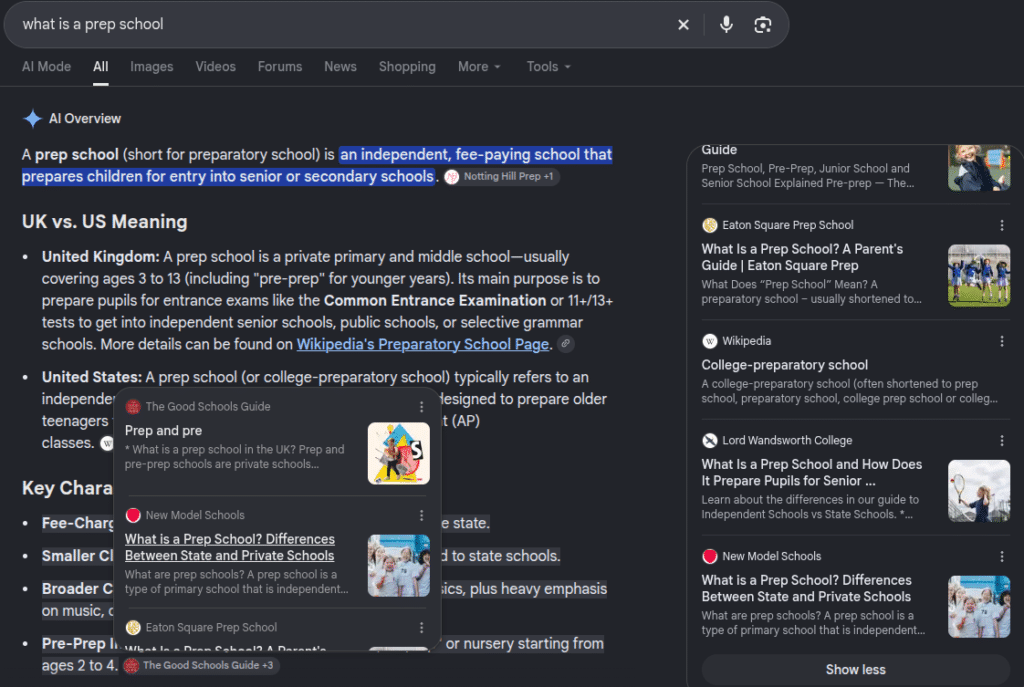
Our client the New Model School Company, which has two prep schools in London, appears for the query ‘what is a prep school’ in the Google AI Overview and Perplexity, at the time of writing.

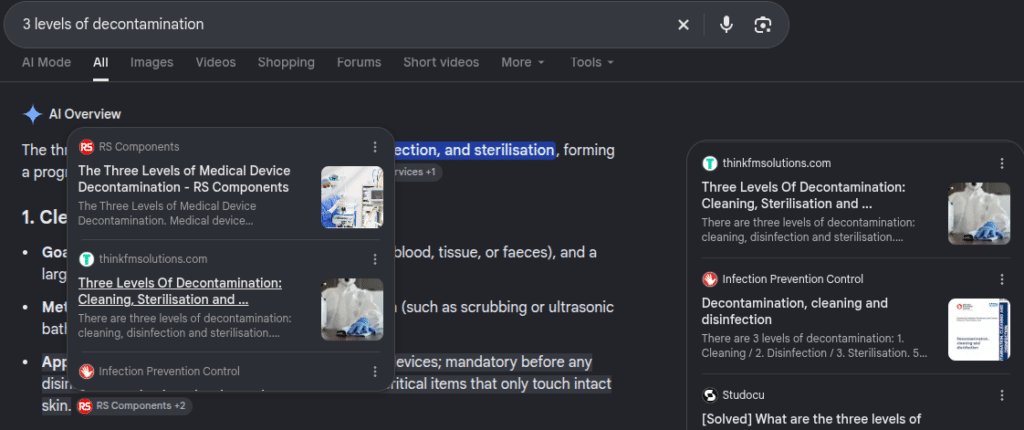
In this example below, our client Think FM Solutions, a commercial cleaning company serving London, appears as a source in the Google AI Overview for a query around the three levels of decontamination.
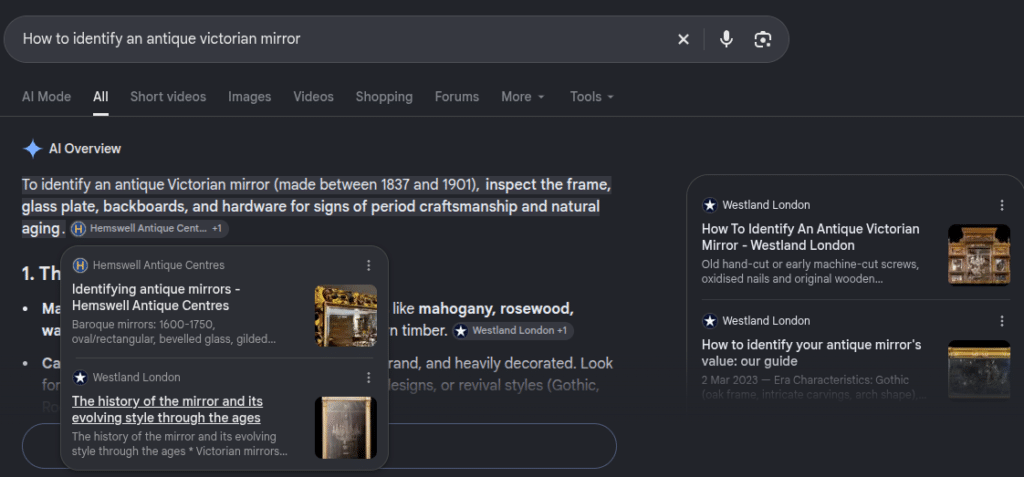
And our client Westland London is the main source in the AI Overview for the query ‘how to identify an antique victorian mirror’ with three separate articles used as sources:
- Victorian mirror guide: How to identify an antique Victorian mirror
- The history of the mirror and its evolving style through the ages
- How to identify your antique mirror’s value: our guide
Westland London is also currently a source in the answer to the same query in Perplexity.

GEO vs SEO vs AEO: what are the differences?
Alright then, let’s get to the bottom of the differences between GEO, SEO and AEO once and for all:
GEO: generative engine optimisation
- Improving visibility in AI-generated responses, such as those from ChatGPT, Claude etc. and the AI search features on Google.
- Aiming to earn source citations, brand mentions or relevant recommendations.
- It involves making content clear, credible and accessible, alongside maintaining accurate information about the business across its online presence.
AEO: answer engine optimisation
- Focuses on making content suitable for direct answers to users’ questions.
- Can cover things like featured snippets, voice responses and AI-generated answers too.
- Often involves clear question-led headings, concise answers and supporting explanations that make information easy to extract and understand.
SEO: search engine optimisation
- Helping search engines i.e. Google to discover and understand your content so people can find it through organic search.
- Covers technical performance, useful content, internal linking and other factors that support search visibility.
- Attracts relevant visitors and generates enquiries or sales. Its scope includes traditional results and Google’s AI search features, rather than just a list of blue links.
So in short, there’s a lot of overlap and marketers often use AEO and GEO fairly interchangeably.
How do generative search engines find information?
Generative search engines find information by retrieving relevant material from the web and combining it with the model’s existing knowledge.
When someone asks a question, the system turns it into several searches, identifies useful sources and uses selected information to generate an answer with supporting links.
Google calls its approach a query fan-out: running related searches across different aspects of a question to find supporting pages.
These systems do not necessarily read every page or evaluate your business’s entire online reputation. Results depend on the platform, question and available sources, so answers and citations can change between searches.

Which platforms should your business target for GEO?
The aim is to appear on the platforms your customers are using.
According to Oxford University research, roughly 58% of UK adults have used generative AI, with about 35% using it at least weekly.
The top AI tools and LLMs by consumer preference, based on YouGov data, are:
- ChatGPT (OpenAI): 30.0%
- Amazon Alexa: 12.7% (a voice assistant with some generative AI features)
- Microsoft Copilot: 11.6%
- Google Gemini: 11.3% (but growing fast due to Search and workspace integration)
- Anthropic Claude: 4.3% (seeing significant audience growth in 2026)
- Apple Siri: 4.0%
- Grok (xAI): 1.9%
- Meta AI: 1.5%
- Apple Intelligence: 0.7%
- Perplexity AI: 0.6%
However, if your target market is more B2B than B2C, the picture changes. Claude is frequently chosen by UK corporate and financial firms for its long-context reasoning, strong safety guardrails, precision in coding and autonomous agent workflows (e.g. Claude Opus).
No matter who your audience is, Google’s AI features connect with Search, so your current SEO work is still very relevant.
Rather than targeting every platform individually, find out where your customers research. Check your referral traffic (e.g. by using Google Analytics).
Test your visibility and that of competitors yourself by prompting the different LLMs and recording which sources or rivals appear.
For starters, do GEO (or AEO) in general and if you get it to work fairly consistently, with good visibility for your business, maybe then you could look into specific LLM targeting techniques. For example, trying to target Claude specifically.
How do you research GEO questions and prompts?
Start with the questions your customers already ask, then test them in the AI platforms that matter to your business. Use natural, conversational prompts rather than short keywords, because systems such as ChatGPT can search the web and show source links.
Build a prompt set around:
- Buying questions: “best”, “compare”, “pricing”, “alternatives”
- Problem questions: “how to”, “what is”, “why”
- Local questions: “near me”, city or region
- Trust questions: reviews, credentials and recommendations
Log the answer, the cited sources, competitors and whether your brand appears. Repeat the prompts over time, since AI answers can vary.

How do you create content for generative search?
Create content that answers customer questions clearly and adds value beyond generic explanations. Google’s stance is that helpful, reliable, people-first content is central to visibility in AI overviews and AI Mode (just as it was for SEO, really).
Use the customer questions you identified, then structure each page e.g. a new blog post around one clear purpose:
- Answer the main question early
- Add first-hand expertise, examples, pricing logic or local detail where possible to make your content more unique and bespoke
- Cover related subtopics naturally, rather than creating thin pages
- Use descriptive headings, concise paragraphs, images and video where useful
- Keep facts current and cite credible sources
Avoid mass-produced, commodity content. This is maybe where things have changed in recent years.
It used to be that a small business could get on page 1 for generalist blogs via some clever keyword targeting. But now the bigger companies tend to get prioritised as sources for AI answers more consistently.
Instead, one tactic for smaller businesses now struggling for online visibility is to make your content more regional. Don’t try to compete with national or multinational brands on blog topics, but make your content more local instead – e.g. “How to repair your boiler in Kent” or “What does a new XYZ cost in Manchester?”
Ways of demonstrating expertise and credibility for GEO
Prioritise demonstrating your expertise by publishing content that only your business could produce: e.g. case studies, original data, client outcomes, process explanations, product testing and first-hand insights.
Google’s E-E-A-T framework emphasises experience, expertise, authoritativeness and trustworthiness.
Make your credibility clearly visible, where possible:
- Add named author profiles with relevant qualifications and links.
- Show who reviewed medical, legal or financial content.
- Cite primary sources and explain your methodology.
- Keep your About, contact, privacy and policy pages clear.
- Use accurate business details, reviews and consistent local listings.
- Earn mentions from reputable industry sites, partners and media.
For good GEO results, originality is really important: Google recommends unique, non-commodity content with a first-hand point of view, supported by a crawlable site and useful images or video.
What technical foundations does GEO need?
You need the same technical basics for traditional SEO and GEO: pages must be crawlable, renderable and indexable.
Make sure your important content is available without login walls, avoid accidental noindex tags, use crawlable internal links and submit an XML sitemap.
Google notes that JavaScript pages must be crawled, rendered and indexed. Robots.txt controls crawling rather than indexing.
Also prioritise fast, mobile-friendly pages, a clear URL structure, valid HTML metadata, accessible images and stable canonical URLs.
If the AI crawlers are important to your strategy, review their access separately from Googlebot and make a deliberate policy decision rather than blocking them by default.
Does structured data help with GEO?
Yes, but indirectly. Structured data helps search engines understand page content and entities, such as your organisation, products, articles, FAQs, reviews and authors. Google uses it to understand pages and gather information about people, companies and other entities.
Use JSON-LD and mark up only what is actually on the page. Relevant types include Organization, LocalBusiness, Product, Article, FAQPage where appropriate, Review and author details.
Validate it with Google’s Rich Results Test, keep your pages crawlable and maintain a sitemap. Google no longer shows FAQ rich results, as confirmed by Search Engine Journal.
Structured data will not force an AI engine to cite you, but it reduces ambiguity.

How do you measure GEO performance?
At the moment, this isn’t as straightforward as measuring SEO, but there are a few things you can do to track your GEO performance, such as:
- Prompt visibility: Run a fixed set of customer questions in ChatGPT, Google AI Mode etc. and record whether your brand is mentioned, recommended or cited.
- Citation share: Track how often your domain appears as a source, which pages are cited and which competitors appear instead.
- Referral traffic: In your Google Analytics, review Traffic acquisition and referral sources to identify visits from AI platforms and track engagement, conversions and revenue.
- Commercial impact: Measure leads, enquiries, demo requests, sales and assisted conversions.
- Search performance: Use Google Search Console for impressions, clicks, CTR and queries. It shows how your site performs in Google Search, though AI Overview data is included in overall web results rather than isolated.
Paid tools such as Ahrefs, Semrush and similar platforms can also monitor your AI citations, brand mentions and so on beyond Google AI Mode e.g. on ChatGPT, Claude etc.
A simple GEO action plan for your business
- Choose your priority questions. List your main customer questions about products, pricing, comparisons, problems and locations.
- Test the AI answers. Run those questions monthly in Google AI Mode, ChatGPT and Claude then record whether you are mentioned, cited or absent, and note competing sources.
- Fix the basics. Ensure priority pages are crawlable, indexable, fast, mobile-friendly and eligible for snippets on Google Search.
- Improve your content. Replace generic pages with first-hand expertise, examples, original data, clear headings and useful images or video.
- Strengthen your credibility. Add author profiles, credentials, reviews, accurate business details and relevant structured data.
- Measure the results. Track citations, Search Console clicks and queries, GA4 referral traffic, conversions and more. Consider using paid tools if relevant.
- Iterate. Update weak pages and repeat the prompt tests monthly.
UWP Group: a leading GEO agency (UK)
If you need a GEO/SEO agency to reach more potential customers, UWP Group is ready to help.
We are digital marketing experts with many 5-star reviews over several years, as a GEO agency London, UK and overseas brands trust.
We are London SEO specialists, now helping our clients with their AEO and GEO needs too. We hope you found this guide useful and if so, check out our recent industry-specific guides, including:
Recently we have also published in-depth guides on:
And for AI/GEO agency services, please don’t hesitate to contact us.