What is AEO vs SEO? AEO Meaning and How To Do It
Summary: What is AEO?
- AEO (answer engine optimisation) helps make your website more likely to be cited in AI-generated answers from Google AI Overviews, ChatGPT, Perplexity and other platforms.
- SEO and AEO work together: SEO is about earning organic visibility in search results, while AEO makes content easier for answer engines to retrieve, understand and quote.
- Write answer-first content by using questions in your headings, giving concise answers, with clear facts and structured formats such as lists, steps and comparison tables.
- Build trust beyond your website through consistent brand information, authentic reviews, relevant directory profiles and third-party mentions.
- Measure your AI visibility by monitoring AI Overview performance, testing a consistent set of buyer prompts, tracking citations or mentions and comparing your share of voice with competitors.
AEO vs SEO
AEO (answer engine optimisation) is about structuring your content so that AI answer engines, for example Google AI Overviews or ChatGPT, trust and cite your information in their answers.
In contrast, SEO (search engine optimisation) has always been about earning a ranking in a list of links, usually meaning that you’re optimising your content to rank highly on page 1 of Google.
It used to be that the holy grail of organic search marketing was to get your blog appearing as the first result on Google for a keyword. Now it’s about trying to get your content cited in an AI-powered answer to a search query.
AEO is now crucial because Google is answering more and more user search queries with these summaries at the top of page 1, so many searchers aren’t looking at the list of links below it.
The first traditional organic search result on the Google SERP (search engine results page) is now fairly low down, after the AI Overview summary and sponsored results.
This change, first publicly introduced in around mid-2024 but growing significantly ever since, is reducing organic click-through rates (CTR).
At the same time, it’s increasing the value of being a source that AI tools name and link to in their summaries. ChatGPT, Perplexity and other LLMs also provide these AI summaries, citing links as sources.
AI Overviews currently appear on up to 48% of all queries on Google, according to Semrush data as reported by Search Engine Roundtable.
How do answer engines work?
Answer engines retrieve passages of text (usually) from the web, verify them across multiple sources and then generate a concise response with citations.
When you ask a question, the system:
- Sends related queries to its index
- Pulls candidate snippets
- Checks for consistency and authority
- Assembles a summary that directly addresses the search intent
Therefore, your aim needs to be providing clear, self-contained answers and consistent facts across your website and third‑party profiles.
‘Access’ is also important. Google’s AI crawlers and others such as GPTBot or PerplexityBot need to fetch your pages, otherwise they can’t consider your content for citation.

How do you write for AEO?
To increase your chances that an AI answer will cite you, make content that’s easy to retrieve, verify and quote:
- Start by writing the answer first: open each section with a direct response to the headline question before adding context.
- Structure your pages around real user or customer questions, using question headings that match what people ask.
- Make sure you name your brand, service, location, key people etc. early on, so that the engine can attribute the answer.
- Prioritise precision over fluff: where possible, include specific facts and figures, ideally proprietary ones that only you or your business has.
- Make sure each section works independently from the rest of the page, so it makes sense even if it’s lifted out as a standalone snippet for an AI summary.
For blogs, other common tactics include adding a short article summary near the top and a FAQ section near the bottom.
AEO by funnel stage
Different stages of the buyer journey need slightly different AEO tactics.
At the top or middle of the funnel, focus on things like explainers, checklists, frameworks and step‑by‑step how‑to guides structured in a clear Q&A format. This type of content frequently gets pulled into AI answers for “what is” and “how to” queries.
For your bottom of the funnel intent you can prioritise comparisons, “best X for Y” guides, pricing pages, case studies and implementation guides. AI engines often cite these when users are close to a purchase decision.
What is local AEO?
Local AEO is about getting named and described accurately inside AI-generated summaries for queries such as “plumber near me” and for this, focus on:
- Optimise your Google Business Profile (name, categories, services, hours, areas) and keep your name, address, phone number (NAP) consistent across directories and your site’s LocalBusiness schema
- Publish short, direct FAQs and how‑tos that match local questions, e.g. “how to get a job in Leeds”
- Post regular GBP updates, encourage reviews that mention specific services and build up your local citations or mentions, so that AI can verify your expertise and coverage
This makes your business a trusted entity that answer engines can recommend in local AI Overviews.
How to do on-page AEO
To make your pages easier for answer engines to extract and cite, we recommend:
- Opening each section of your content with a 40–60 word answer in the first one to two sentences, then expand on it with supporting detail.
- Question headings: phrase most of your H2s and H3s as the exact questions customers ask (“What is AEO?”, “How do I optimise for AI Overviews?”) and place the answer immediately below.
- Scannable structures: use short paragraphs, bullet point lists for tips or benefits etc., numbered steps for processes and tables for comparisons.
- Structured data: use FAQPage schema for Q&A blocks, HowTo schema for step-by-step guides, and Article/BlogPosting schema for context, ensuring the markup matches the visible content.
- Reinforcing your brand, services, locations etc. early on and in Organization/LocalBusiness schema so that the engines can attribute answers to the right entity.
Off-page AEO
Off-page AEO is about building the external mentions and validations that tell AI engines your brand is real, trusted and worth citing. Answer engines treat third‑party references as stronger proof than your own site, so for this, focus on:
- Earned media and PR: Try to secure coverage in industry publications, trade press and analyst reports because these mentions carry significant weight in AI answers.
- Review and comparison sites: Maintain complete, active profiles on popular platforms or websites such as Trustpilot or G2 and industry‑specific directories, aiming for a high number of reviews and consistent 5-star ratings.
- Community presence: Participate on Reddit, LinkedIn, Quora and industry-specific forums so that your brand or experts are mentioned where buyers are discussing solutions to needs or problems.
- Consistency: Align your name, role, bio and expertise across LinkedIn, your About page, guest posts, podcasts and directories so that AI can confidently associate your brand with your topics.
How to track AEO performance
Right now, measuring AEO performance is more piecemeal than SEO, but there are a few things you can do.
It’s easy to track your SEO using Google Search Console or Analytics, but at the time of writing, Google’s generative AI performance tracking isn’t as detailed yet, arguably.
Google Search Console – Generative AI report
Open the Performance report and then the Generative AI features section to see AI Overview and AI Mode impressions by page, country, device and date.
You can treat this as a ‘visibility’ signal. It shows how often your links appear inside AI surfaces, but not clicks, CTR or queries yet.
Compare AI impressions to total Search impressions. If you have a meaningful AI share (e.g. 10-15%+), prioritise AEO work on those pages.
Brand mention tracking across AI engines
Build a prompt library of real buyer questions and run them regularly in ChatGPT, Perplexity, Gemini and the Google AI Overviews.
For each run, log whether your brand is mentioned, cited (a domain in the sources section), recommended (in a list or “best” context) and the sentiment.
Track your ‘share of voice’ by noting which competitors appear alongside you and how often.
Optional tools and automation
Use third-party AEO or brand‑monitoring tools to automate prompt runs, mention detection and reporting for a fee.
FAQs about AEO
What is AEO SEO?
It’s not called AEO SEO, these are two different practices. They are both about optimising your content to improve your chances of customers seeing your brand when searching online, but while there is some overlap, you do AEO and SEO in different ways.
What’s the difference between SEO and AEO?
SEO is to help you rank highly in a list of links, usually targeting Google page 1. AEO is to try earning a citation inside AI-generated answers.
You still need SEO, but AEO is so that AI engines are more likely to name and recommend your brand.
How long does it take to see results from AEO?
You can expect early visibility changes within a few weeks when you start publishing this style of answer-first content.
Then you may see more stable citation patterns emerging over 3-6 months if you do it consistently.
Is AEO just for big brands?
No, small and local businesses can get AI citations too.
Just as there were some keywords which were dominated by big brands with SEO, there are some search questions where it’s more likely that answer engines will only look at the big brands.
But with a well-optimised Google Business Profile, consistent publication of localised content that answers your customers questions and good off-page AEO, small businesses can appear in AI answers too.
UWP Group: a leading AEO agency
If you need an AEO service, look no further than UWP Group, a digital marketing agency with many 5-star reviews over several years for our London SEO service and now working with our clients on AEO.
We have successfully achieved many mentions for our clients in AI Overviews on Google by writing their content for them.
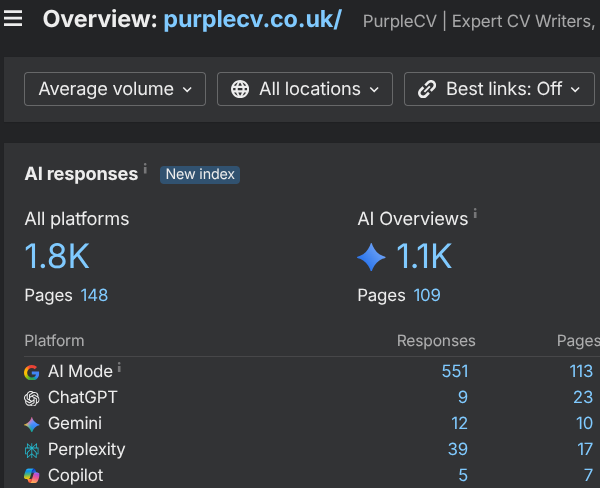
For example, we have written and kept optimised more than 250 blog posts for our client PurpleCV over the years. We achieved many #1 rankings on Google for a wide range of relevant keywords through SEO during this time and now, PurpleCV is getting 1.1k mentions in AI Overviews and 1.8k AI mentions overall, according to Ahrefs data.
We hope you found this guide useful. If so, check out our recent guide on technical SEO and our industry-specific SEO guides, including:
If you need an AEO expert, please don’t hesitate to contact us.